
Turkey Tail Mushroom: Benefits, Research and Limits
What turkey-tail studies show, why clinical PSK differs from retail supplements, and how to check product labels without overstating immune-health claims.
in dit artikel
Evidence for clinical turkey-tail preparations does not prove that retail supplements improve everyday immunity or treat cancer. The preparation, patient group and measured outcome matter. This guide explains what the cited studies examined and how to separate that evidence from a product label.
Turkey tail, PSK and PSP are not interchangeable terms
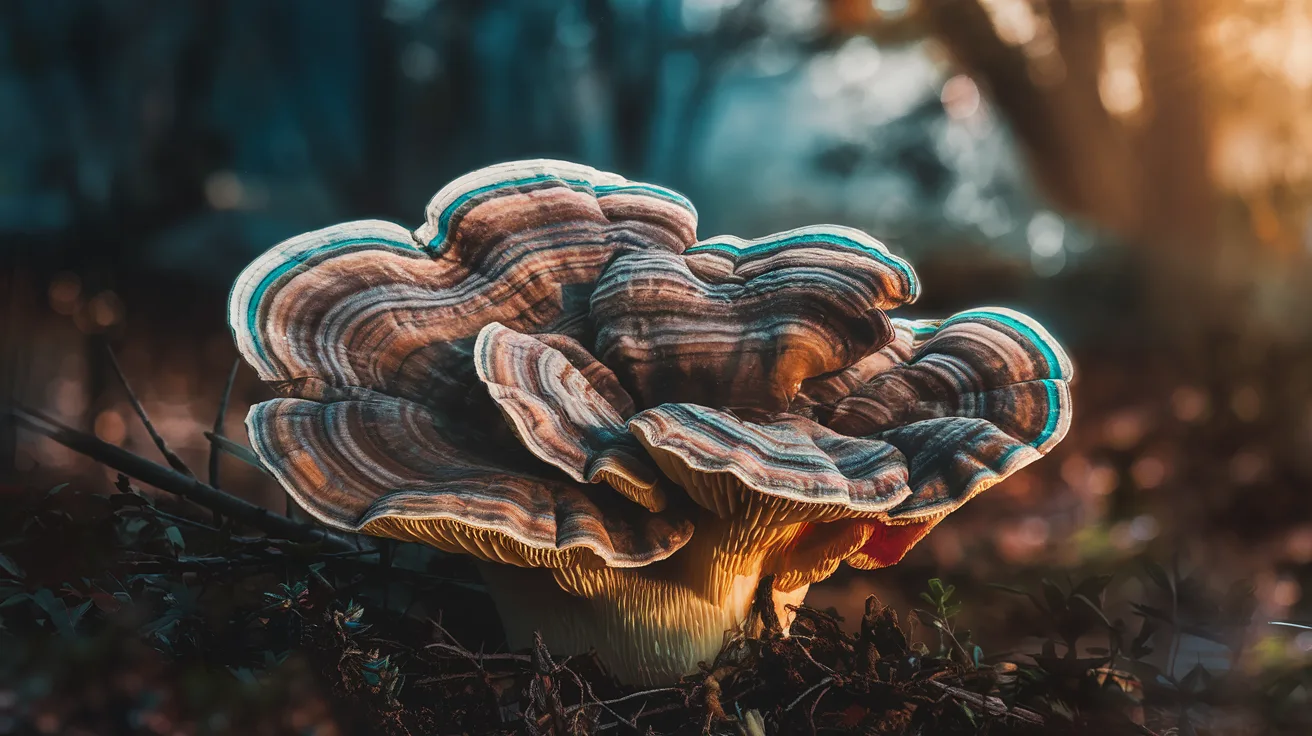
Turkey tail is Trametes versicolor, also called Coriolus versicolor. NCI describes PSK, or Krestin, as a proprietary preparation derived from cultivated mycelium and used as an adjunct to cancer treatment in Japan. PSP is another turkey-tail extract. These terms do not identify every powder, capsule or tincture sold as turkey tail. Source: NCI Medicinal Mushrooms (PDQ), turkey-tail section.
| Preparation | What to distinguish |
|---|---|
| Clinical PSK | A defined preparation studied with particular cancer-treatment regimens. |
| PSP | A different extract; a PSK result cannot simply be assigned to PSP. |
| Retail turkey-tail supplement | Its identity, composition and evidence must be checked individually. |
What the cancer research can tell us
NCI summarizes trials of PSK alongside conventional treatment, including gastric and colorectal cancer studies. Some reported benefits, while other comparisons did not show an overall benefit. The studies used different patient groups, regimens and designs. NCI's summary is an evidence resource, not a treatment guideline. Read the study-by-study PDQ assessment.
Our interpretation: those findings cannot be turned into a universal survival percentage or a claim that a shop-bought supplement is an equivalent intervention. This article does not recommend a cancer-treatment dose or a replacement for prescribed care.
The 2012 breast-cancer study: a small safety study
Torkelson and colleagues' original phase I paper recruited 11 women; nine completed six weeks of treatment after radiotherapy. The study used freeze-dried mycelial powder, not PSK or a generic fruiting-body extract. Three women completed each dose cohort. Its primary purpose was safety and tolerability; immune measurements were exploratory.
The authors reported trends in some immune measures. This was not a randomized efficacy trial. Some analyses also used an earlier observational group. The study did not establish that turkey tail prevents recurrence, extends survival or prevents infections in healthy people.
Nine adverse events were reported: seven mild, one moderate and one severe. An event reported during a trial is not automatically caused by the study product. These findings also cannot establish indefinite safety across other products or populations. See the methods, adverse-event table and discussion.
What about everyday “immune support”?
Ask what a claim actually promises. A change in an immune-cell measurement, fewer respiratory infections and improved cancer survival are different outcomes. The studies discussed here do not answer all three questions.
Before accepting an everyday-health claim, look for a study that matches the intended population, the exact preparation and a meaningful outcome. “Studied in cancer patients” is not enough detail. Neither a large bibliography nor a high beta-glucan number substitutes for that match.
A practical label and source check
FDA explains that the Supplement Facts panel identifies serving size and dietary ingredients; amounts for individual ingredients within proprietary blends may not be disclosed. It also states that supplements are not approved for safety and effectiveness before marketing. Source: FDA questions and answers on dietary supplements.
Our editorial checklist focuses on what a product actually documents:
- Identify the material. Record the species, whether the product lists mycelium or fruiting body, and whether it describes a powder or extract. Do not assume one label term proves clinical superiority.
- Compare like quantities. Separate capsule weight, serving size, total blend weight and the disclosed amount of turkey tail. Mark missing amounts as unknown.
- Read the actual laboratory document. Check the product and lot, date, test method, units and which analytes were tested. A logo or a “lab tested” badge does not show those details.
- Keep composition separate from effectiveness. A measured beta-glucan percentage describes a sample. It does not identify clinical PSK or demonstrate a treatment outcome.
- Keep the source trail. Save the original label or laboratory link and the date you checked it. If the source cannot be matched to the current product, record that gap.
Use our label and laboratory-data research hub to compare documented fields and missing evidence. A listing in that dataset is not a medical recommendation. Our COA reading guide explains the document fields in more detail.
Discuss the exact product with your care team
FDA advises consulting a health professional before taking a supplement, particularly because supplements can affect medicines or medical conditions. If you are receiving cancer treatment, bring the actual label and any laboratory report to your oncology team before adding a product. Do not substitute a supplement for prescribed treatment. FDA supplement safety information.
Sources and editorial update
Editorially revised on September 9, 2026. Original publication: February 12, 2026. This revision removed unsupported dose recommendations, generalized benefit claims and trial percentages that were not supported by the cited primary material. No new medical review is claimed.
- NCI: Medicinal Mushrooms (PDQ), Health Professional Version. The source displays an update of November 6, 2024; accessed September 9, 2026.
- Torkelson CJ et al. Phase 1 Clinical Trial of Trametes versicolor in Women with Breast Cancer. ISRN Oncology, 2012; article 251632. DOI: 10.5402/2012/251632.
- FDA: Questions and Answers on Dietary Supplements. Accessed September 9, 2026.
Tags
Frequently Asked Questions
What does this article about "Turkey Tail Mushroom: Benefits, Research and Limits" cover?
What turkey-tail studies show, why clinical PSK differs from retail supplements, and how to check product labels without overstating immune-health claims.
Who prepared this article?
This source-linked research summary was prepared by the ShrooMap Editorial Team. No medical review is claimed for this revision.
What topics are related to this article?
This article covers topics including turkey tail, PSK, clinical research, supplement labels, evidence limits. Explore our blog for more articles on these subjects.
Verwante artikelen


⚖️ Productvergelijkingen
Verken de paddenstoelenwereld
Duik dieper in de soortprofielen, vergelijk producten en vind winkels bij jou in de buurt.