
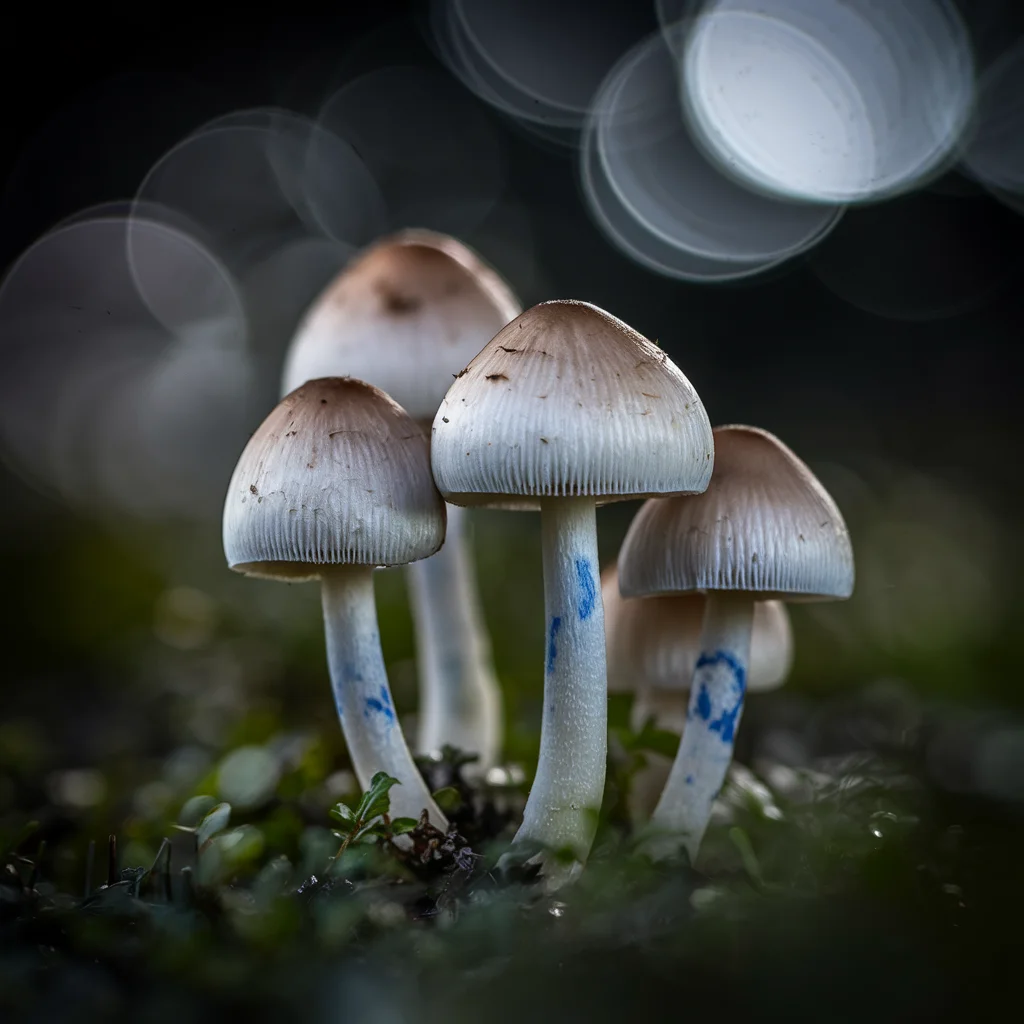
Panaeolus cyanescens (syn. Copelandia cyanescens) is a potent psilocybin-producing basidiomycete of the family Bolbitiaceae, order Agaricales, widely distributed across tropical and subtropical regions worldwide. It is characterized by a small to medium pileus (1.5–4 cm), initially hemispheric becoming broadly convex, light brown to greyish-white, with a thin, fragile stipe (7–12 cm) that bruises intensely blue. Unlike most Psilocybe species, P. cyanescens is coprophilous, fruiting on cattle and horse dung in warm, humid grasslands. It is significantly more potent than Psilocybe cubensis, with psilocybin and psilocin concentrations approximately 2–3 times higher by dry weight. Importantly, P. cyanescens should not be confused with the Psilocybe cubensis strain marketed as 'Blue Meanie' — they are entirely different species in different genera, a distinction critical for harm reduction and accurate dosing.
#33
Classifica di popolarità
Moderate
Livello di ricerca
3
Riferimenti
4
Composti chiave
Psilocybin
Independent Research Review · Ultima revisione 25 febbraio 2026
PANORAMICA SCIENTIFICA.
Grado di evidenza: B
Blue Meanies dispone di un supporto di ricerca moderato con diversi studi preclinici e alcuni studi clinici sull'uomo. Sono necessarie ulteriori ricerche per confermare i benefici.
Punto chiave
Blue Meanies — Panaeolus cyanescens — are a potent tropical psilocybin mushroom that grows on cattle and horse dung in warm, humid grasslands across the tropics and subtropics. They are found...
Uso tradizionale
Blue Meanies è stato utilizzato nei sistemi di medicina tradizionale per secoli, in particolare nella Medicina Tradizionale Cinese (MTC) e in altre pratiche di guarigione asiatiche.
Contesto storico: L'uso tradizionale non garantisce efficacia o sicurezza. La ricerca moderna è in corso per validare le affermazioni tradizionali.
Blue Meanies — Panaeolus cyanescens — are a potent tropical psilocybin mushroom that grows on cattle and horse dung in warm, humid grasslands across the tropics and subtropics. They are found naturally in Hawaii, Southeast Asia, Central and South America, Australia, and parts of Africa, making them one of the most widely distributed psilocybin species on Earth. The name "Blue Meanies" refers to the intense blue bruising that occurs when the mushroom's flesh is damaged — a visual indicator of psilocybin oxidation.
A critical point of confusion must be addressed: Panaeolus cyanescens (the true Blue Meanies) is a completely different organism from the Psilocybe cubensis strain also marketed as "Blue Meanie." They belong to different genera, have different potencies, different habitats, and different appearances. True Blue Meanies (Panaeolus) are significantly more potent than any P. cubensis strain — roughly 2–3 times stronger by dry weight. Confusing the two can lead to serious dosing errors, making this distinction essential for harm reduction.
The experience produced by true Blue Meanies is described as euphoric, highly visual, and energetic compared to the often more introspective quality of P. cubensis. Users report vivid color enhancement, geometric patterns, a sense of lightness and joy, and enhanced appreciation for music and nature. The higher potency means that effects come on faster and can be more intense than expected for those accustomed to cubensis dosing. A moderate dose is typically 1–2 grams dried, compared to 2–3.5 grams for cubensis.
Blue Meanies have a long history of traditional use in tropical cultures. In Thailand, they grow abundantly on buffalo dung and have been consumed in the islands of Koh Samui and Koh Pha-Ngan for generations, both by local communities and by travelers. In Hawaii, they fruit year-round in cattle pastures and have been part of the local psychedelic culture for decades. In Bali and other parts of Southeast Asia, they are the primary wild psilocybin species encountered.
Identification of Panaeolus cyanescens requires attention to several key features: a light brown to greyish-white cap that does not typically have the golden-brown coloring of cubensis; a thin, fragile stem that bruises blue; dark black spore print (not purple-brown like Psilocybe); and growth directly on dung in tropical/subtropical grasslands. The black spore print is a critical distinguishing feature from Psilocybe species.
Blue Meanies are widely cultivated by hobbyist mycologists in jurisdictions where this is legal, as they grow readily on pasteurized dung-based substrates. They are not sold commercially as a finished product in most markets. For those in legal jurisdictions: respect the higher potency, start with a lower dose than you would with cubensis, and follow standard harm reduction practices — comfortable setting, trusted companion, clear schedule, and no mixing with other substances.
Blue Meanies Dosaggio
Queste informazioni sono solo a scopo educativo e non devono sostituire il parere medico professionale. Consultare sempre un professionista sanitario qualificato.
SPECIE SIMILI.
Revisionato medicalmente da
Independent Research Review
Independent editorial team reviewing product labels, COAs, regulator records, and cited scientific literature. our editorial team reviews all mushroom encyclopedia entries for scientific accuracy, ensuring claims are supported by peer-reviewed research.
Last reviewed: 25 febbraio 2026
Click anywhere or press Escape to close