
Cordyceps and Libido: Does the 'Himalayan Viagra' Actually Work?
A physician reviews the research on Cordyceps sinensis and Cordyceps militaris for libido, testosterone, and sexual health — separating folklore from evidence.
Independent Research Review · Published May 16, 2026

📑 En este artículo
- A Quick Taxonomy Note (That Matters for Dosing)
- The Testosterone Question
- Sperm Quality: The More Solid Data
- Erectile Function: The Diabetic Rat Model
- How Does It Compare to Other "Natural" Options?
- What About Women?
- Dosing, Forms, and What to Look For
- The "Himalayan Viagra" Label — Fair or Hype?
- Frequently Asked Questions
I have a confession: the first time a patient asked me about Cordyceps for their libido, I did what most conventionally-trained physicians do — I smiled politely, made a vague noise about "limited evidence," and moved on. That was a mistake, because the evidence is actually more interesting than I gave it credit for.
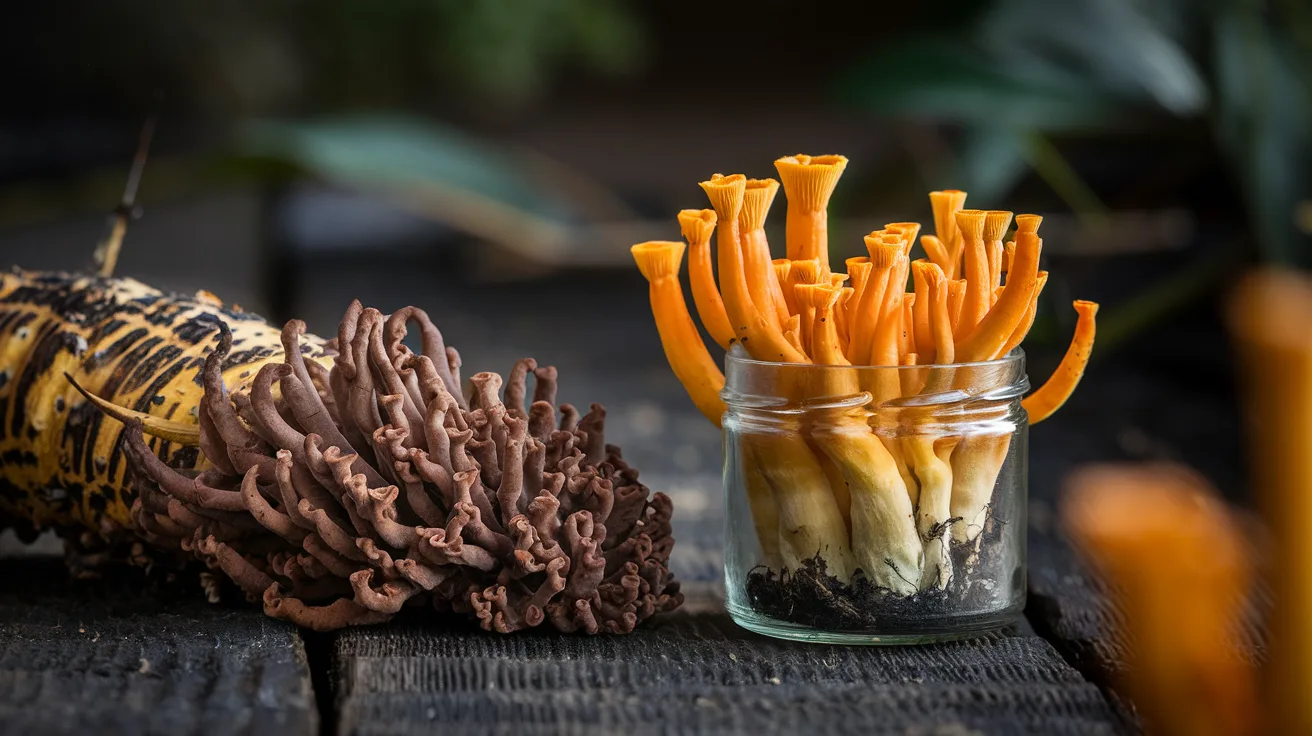
Cordyceps is a parasitic fungus that, in the wild, hijacks the body of a caterpillar larva in the high-altitude grasslands of Tibet and Nepal, eventually erupting as a fruiting body from the caterpillar's head. It looks like something from a horror film. And for over a thousand years, Tibetan and Chinese medicine practitioners have used it as a kidney tonic and — yes — an aphrodisiac. Yak herders apparently noticed that their animals were unusually frisky after grazing on Cordyceps-rich pastures. The rest is ethnobotanical history.
But does any of that hold up to scrutiny? Let's look at the actual research.
A Quick Taxonomy Note (That Matters for Dosing)
When people say "Cordyceps," they usually mean one of two species: Cordyceps sinensis (now technically reclassified as Ophiocordyceps sinensis) or Cordyceps militaris. The wild-harvested CS is extraordinarily expensive — sometimes thousands of dollars per kilogram — because it can only be harvested from caterpillar larvae at altitude. Almost every supplement on the market uses cultivated C. militaris or fermented CS mycelium, both of which are far more practical and, arguably, more consistent in their active compound content.
This distinction matters because the two species have somewhat different bioactive profiles. C. sinensis research tends to focus on steroidogenesis (testosterone production), while C. militaris studies emphasize cordycepin and its effects on sperm quality and erectile function. When you're shopping for a supplement, knowing which species — and which part of the mushroom — is in the capsule is worth the five seconds it takes to read the label.
The Testosterone Question
The most mechanistically compelling data comes from Taiwanese researchers studying how Cordyceps affects Leydig cells — the testicular cells responsible for making testosterone. A 2004 study published in Life Sciences by Huang et al. fed mice different fractions of C. sinensis mycelium for up to seven days and measured plasma testosterone via radioimmunoassay. Both immature and mature mice showed statistically significant increases in testosterone after treatment with the whole extract and two active fractions (F2 and F3), at doses of 0.02–0.2 mg/g body weight. The effect appeared within three days and was reproducible across multiple preparations. (DOI: 10.1016/j.lfs.2004.01.029)
A 2016 review in the Journal of Food and Drug Analysis by Chen et al. synthesized the broader picture: both C. sinensis and its key nucleoside compound cordycepin appear to stimulate Leydig cell steroidogenesis through multiple intracellular pathways, including cAMP/PKA signaling and StAR protein upregulation — the same pathway that LH (luteinizing hormone) uses to trigger testosterone synthesis. In plain English: Cordyceps seems to mimic or amplify the hormonal signal that tells your testes to make testosterone. (DOI: 10.1016/j.jfda.2016.10.020)
I want to be careful here. These are primarily animal and cell studies. We do not have a well-powered, placebo-controlled randomized trial in humans showing that Cordyceps raises testosterone in men with normal or low-normal levels. What we have is a compelling mechanistic story that the plumbing is there — but the clinical translation hasn't been fully tested.
Sperm Quality: The More Solid Data
If the testosterone story is "interesting but provisional," the sperm quality data is a bit more robust — at least in rodent models. A 2008 study in the American Journal of Chinese Medicine by Chang et al. supplemented male Sprague-Dawley rats with 1% or 5% C. militaris mycelium in their diet for six weeks. Epididymal sperm count increased significantly by week five in both groups, peaking at week six. Importantly, both sperm motility and serum testosterone rose in parallel, and the effect persisted for two weeks after stopping supplementation. FSH, LH, and prolactin were unchanged, which suggests the action was at the testicular level rather than through the pituitary. (DOI: 10.1142/S0192415X08006296)
The "maintained effect after stopping" part is clinically interesting. It suggests Cordyceps may be modifying the testicular environment rather than acting as a simple hormone secretagogue that disappears when you stop taking it. The researchers hypothesize this is related to cordycepin's half-life and downstream effects on Sertoli cell function, though that mechanism is still being worked out.
Erectile Function: The Diabetic Rat Model
A 2020 paper in BioMed Research International by Pohsa et al. studied C. militaris in streptozotocin-induced diabetic rats — a well-established model for diabetic erectile dysfunction (ED). Diabetic ED is a clinically significant problem because diabetes damages both nitric oxide signaling and vascular endothelium, the two pillars of normal erectile function. The rats received oral CM at 0.1, 0.5, or 1.0 g/kg/day for three weeks; a sildenafil group served as a positive control.
The results: CM reversed the diabetes-induced increases in mount latency and intromission latency (behavioral proxies for erectile readiness), improved intracavernosal pressure responses to cavernous nerve stimulation, and elevated penile nitric oxide synthase (NOS) activity. Testosterone and sperm count also normalized. The mechanism appears to involve antioxidant activity — CM significantly reduced testicular malondialdehyde (MDA, a marker of oxidative damage) and increased superoxide dismutase activity. (DOI: 10.1155/2020/4198397)
I find this pathway particularly credible. Oxidative stress is a genuine enemy of erectile function and sperm quality. Any intervention that reduces oxidative damage in testicular and penile tissue has a plausible route to clinical effect. Whether supplemental Cordyceps generates sufficient antioxidant activity in a human male without diabetes is, again, an open question — but the mechanism is sound.
How Does It Compare to Other "Natural" Options?
| Supplement | Evidence Level | Primary Mechanism | Human RCTs? |
|---|---|---|---|
| Cordyceps (militaris/sinensis) | Moderate (animal + in vitro) | Leydig cell stimulation, antioxidant, NOS upregulation | Limited |
| Ashwagandha | Good | Cortisol reduction, LH/FSH support | Yes (small) |
| Maca root | Moderate | Unclear; likely indirect | Yes (small, mixed) |
| Fenugreek | Moderate | 5-alpha reductase inhibition, free testosterone | Yes (small) |
| L-arginine | Moderate | Nitric oxide precursor | Yes (mixed) |
| Sildenafil (Viagra) | Strong | PDE5 inhibition | Yes (many large RCTs) |
To put it bluntly: if you have clinical erectile dysfunction, talk to your doctor about proven treatments. Cordyceps is not a substitute for a conversation with your physician, and it is emphatically not a substitute for sildenafil or tadalafil if you genuinely need them. What Cordyceps may offer is a supportive role for men who want to optimize reproductive health, support healthy testosterone levels, or address mild, lifestyle-related sexual vitality issues — not treat pathology.
What About Women?
The sexual health literature for Cordyceps is almost entirely male-focused, which reflects a broader bias in reproductive research. There is essentially no human data on Cordyceps and female libido specifically. Cordyceps' general effects on energy, fatigue reduction, and adrenal support are relevant to both sexes, and some practitioners use it for female sexual health on those indirect grounds. But I won't pretend there's robust evidence for that specific application — because there isn't.
Dosing, Forms, and What to Look For
Most animal studies used doses equivalent to roughly 1–5 grams of dried mycelium per day in humans when scaled by body weight. Typical supplement recommendations land at 1,000–3,000 mg/day of extract.
- Fruiting body vs. mycelium: For cordycepin content, C. militaris fruiting body products tend to have higher measured cordycepin than mycelium-on-grain products. Check for a third-party COA that quantifies cordycepin or at least total nucleosides.
- CS-4 fermented mycelium: This is the standardized strain used in most Chinese clinical research on C. sinensis. Products listing "CS-4" have more consistent active compound content than generic "Cordyceps sinensis" claims.
- Look for beta-glucan content: A reputable brand will list the polysaccharide/beta-glucan percentage, typically ≥25–30% in a quality extract. This won't directly correlate with cordycepin, but it's a proxy for overall extract quality and production standards.
- Timing: No strong evidence for optimal timing, but given Cordyceps' reputation for energy support, morning or pre-activity dosing makes practical sense. Some men report it takes 4–8 weeks of consistent use before noticing any difference in energy or sexual vitality.
The "Himalayan Viagra" Label — Fair or Hype?
I understand why the marketing copy reached for that comparison. "Himalayan Viagra" is catchy, it moves units, and there's a kernel of biological plausibility behind it. But it's misleading in at least two important ways.
First, the mechanism is completely different. Viagra works by blocking an enzyme (PDE5) that degrades the signal keeping blood vessels relaxed during arousal. Cordyceps works (if it works) upstream — at the level of testosterone synthesis and oxidative stress reduction, not at the acute vascular response. One is a fast-acting pill with effects in 30–60 minutes; the other is a supplement that needs weeks of consistent use and primarily supports the hormonal and cellular environment for sexual function.
Second, the evidence bases are not comparable. Sildenafil has been tested in large, well-controlled human trials. Cordyceps for human sexual health has not. That doesn't mean Cordyceps is ineffective — it means we don't yet know with confidence whether the animal findings translate. I'm genuinely optimistic that some of them do, but optimism is not the same as proven efficacy.
My honest clinical opinion: Cordyceps is a reasonable inclusion in a men's health supplement stack for someone who wants to support testosterone, sperm quality, and energy — particularly if they're dealing with fatigue-driven loss of libido rather than organic sexual dysfunction. The safety profile is favorable, the mechanistic story is credible, and the traditional use record is long. But please approach it as a wellness supplement, not a pharmaceutical intervention. If you're having significant sexual health problems, that conversation belongs in a doctor's office.
Frequently Asked Questions
How long does Cordyceps take to affect libido or testosterone?
Animal studies showing testosterone or sperm quality changes ran for 3–6 weeks at consistent daily dosing. Anecdotally, most men who report effects on energy and libido notice them after 4–8 weeks of regular supplementation. There is no fast-acting effect comparable to a PDE5 inhibitor; this is a slow-burn intervention aimed at the hormonal environment, not the acute vascular response.
Can women take Cordyceps for sexual health?
Cordyceps is generally considered safe for women, and its general benefits — energy, adaptogenic stress modulation, antioxidant support — apply to both sexes. However, there is essentially no direct clinical research on Cordyceps and female libido or sexual function. Women who are pregnant or breastfeeding should consult a physician before taking any mushroom supplement, including Cordyceps.
Is Cordyceps safe to combine with medications for erectile dysfunction?
There are no well-documented direct interactions between Cordyceps and PDE5 inhibitors (sildenafil, tadalafil, vardenafil). However, both Cordyceps and PDE5 inhibitors affect blood pressure to some degree — Cordyceps through nitric oxide pathway support, PDE5 inhibitors through direct vasodilation. If you're taking prescription ED medications, or medications for cardiovascular conditions, discuss any new supplements with your prescribing physician before starting them. This is not the disclaimer I'm required to include; it's genuinely good advice.
Etiquetas
Frequently Asked Questions
What does this article about "Cordyceps and Libido: Does the 'Himalayan Viagra' Actually Work?" cover?
A physician reviews the research on Cordyceps sinensis and Cordyceps militaris for libido, testosterone, and sexual health — separating folklore from evidence.
Who reviewed this article?
This article was medically reviewed by Dr. Blane Schilling, MD, Family Medicine Physician and Integrative Wellness Specialist.
What topics are related to this article?
This article covers topics including cordyceps, libido, testosterone, sexual health, mens health. Explore our blog for more articles on these subjects.
Artículos relacionados

Explorar categorías
⚖️ Comparación de productos
Explora el mundo de las setas
Profundice en los perfiles de las especies, compare productos y encuentre tiendas cerca de usted.