
Lion's Mane vs Adderall: What the Research Actually Says
A science-backed comparison of lion's mane mushroom and Adderall for focus and cognitive enhancement. What does the research really show?

Board-Certified Physician · Medical Reviewer · Published February 8, 2026
📑 In This Article
- How Adderall Works
- How Lion's Mane Works
- The Research: What We Actually Know
- Direct Comparison
- What Users Actually Report
- Can You Combine Them?
- The Stacking Approach
- How to Choose a Quality Lion's Mane Supplement
- The Bottom Line
- The Neuroscience: What Actually Happens in Each Brain State
- The Honest Answer for What People Are Actually Asking
- Frequently Asked Questions
- The Growing Case for Daily Neurological Maintenance
- The Bigger Question: Addressing the Root Causes of Cognitive Dysfunction
- The Future of Cognitive Enhancement: Where This Is All Heading
- Practical Starting Point: Where to Begin if You're Exploring Cognitive Supplements
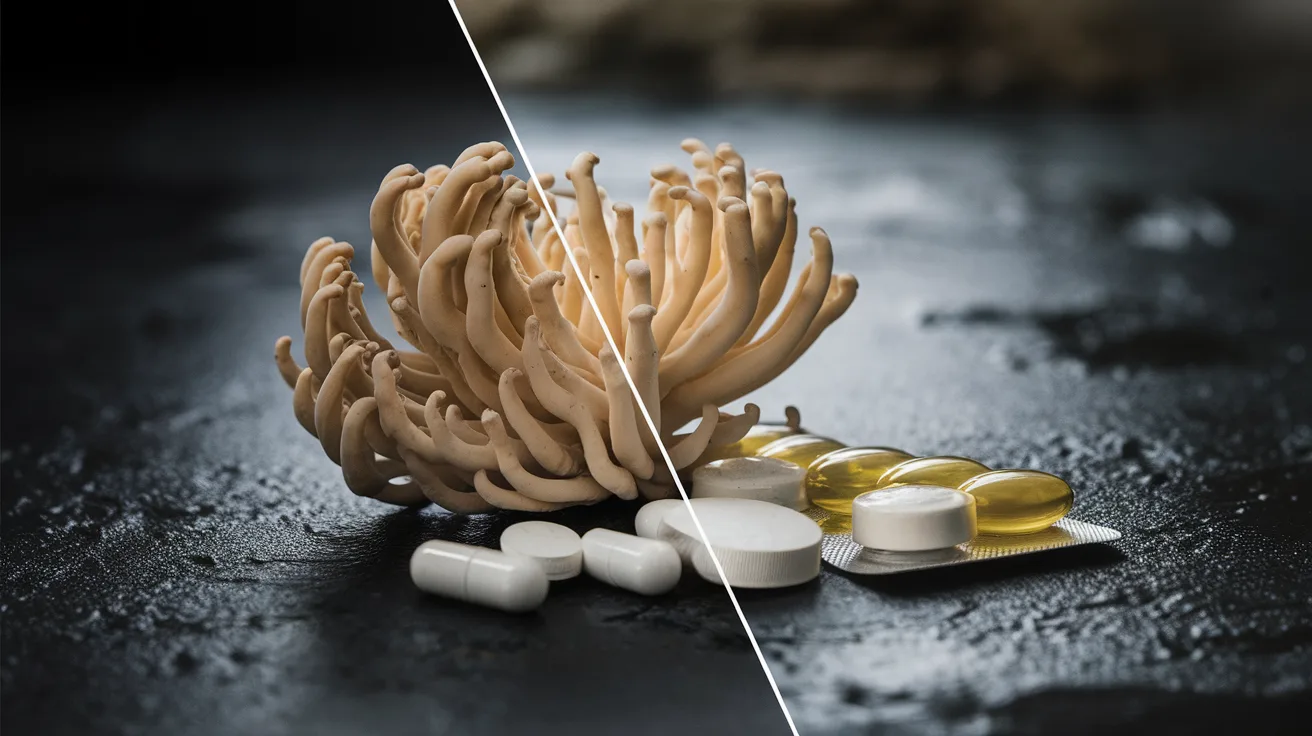
If you've spent any time in nootropic communities, you've seen the claim: "Lion's mane is natural Adderall." It shows up in TikTok videos, Reddit threads, and marketing copy for dozens of mushroom supplement brands. But is there any truth to it?
The short answer: they're fundamentally different substances that work through completely different mechanisms. The longer answer is more nuanced — and more interesting.
How Adderall Works
Adderall is a combination of amphetamine salts (75% dextroamphetamine, 25% levoamphetamine) that increases dopamine and norepinephrine levels in the brain by blocking reuptake and promoting release. It's a Schedule II controlled substance prescribed for ADHD and narcolepsy.
The effects are immediate and pronounced: increased focus, alertness, motivation, and energy. But they come with significant tradeoffs — potential for dependence, cardiovascular stress, appetite suppression, insomnia, anxiety, and a well-documented crash when the medication wears off.
How Lion's Mane Works
Lion's mane mushroom (Hericium erinaceus) contains two unique compound groups — hericenones (found in the fruiting body) and erinacines (found in the mycelium) — that stimulate the production of nerve growth factor (NGF). See our full lion's mane profile.
NGF is a protein essential for the growth, maintenance, and survival of neurons. Unlike amphetamines, lion's mane doesn't flood your synapses with neurotransmitters. Instead, it may support the underlying infrastructure of your nervous system over time.
The Research: What We Actually Know
Lion's Mane Human Studies
The most-cited study is Mori et al. (2009), which gave 30 elderly Japanese adults with mild cognitive impairment either lion's mane or placebo for 16 weeks. The lion's mane group showed significantly improved cognitive function scores — but the improvements disappeared 4 weeks after they stopped supplementation.
A 2023 study from the University of Queensland (Martínez-Mármol et al.) found that lion's mane extract and its active compound N-de phenylethyl isohericerin (NDPIH) promoted neurite outgrowth and enhanced memory in mice. The researchers identified a novel mechanism involving the ERK1 signaling pathway.
A 2020 study (Saitsu et al.) found that 12 weeks of lion's mane supplementation improved cognitive test scores in healthy 50+ year-old Japanese adults compared to placebo.
Nagano et al. (2010) showed that 4 weeks of lion's mane cookies (yes, cookies) reduced depression and anxiety scores in menopausal women compared to placebo.
Key Differences in Evidence Quality
Adderall has decades of rigorous, large-scale clinical research behind it. Lion's mane research, while promising, consists mostly of small studies (typically 30-80 participants), often in elderly populations, with varying extract types and dosages.
We don't yet have large, well-controlled studies examining lion's mane specifically for focus and productivity in healthy young adults — which is the demographic most interested in it as an Adderall alternative.
Direct Comparison
| Factor | Adderall | Lion's Mane |
|---|---|---|
| Onset | 30-60 minutes | 2-4 weeks (cumulative) |
| Mechanism | Dopamine/norepinephrine increase | NGF stimulation |
| Effect type | Acute, strong, time-limited | Subtle, gradual, sustained |
| Dependence risk | Moderate to high | None documented |
| Side effects | Significant | Minimal (rare GI upset) |
| Legal status | Schedule II prescription | Legal supplement |
| Evidence quality | Extensive clinical trials | Promising but limited |
| Cost | $30-300/month (insurance dependent) | $20-50/month |
What Users Actually Report
Anecdotal reports from the nootropic community suggest that lion's mane provides a subtle improvement in mental clarity, verbal fluency, and reduced brain fog — typically noticed after 2-4 weeks of consistent use. Nobody reports the laser-like hyperfocus that amphetamines produce.
The people who seem most satisfied with lion's mane as a "focus supplement" are typically those dealing with general brain fog, mild concentration issues, or age-related cognitive decline — not severe ADHD symptoms.
Can You Combine Them?
Some people use lion's mane alongside prescribed ADHD medication. There are no documented drug interactions between lion's mane and amphetamines, but this should always be discussed with a healthcare provider. Some users report that lion's mane helps smooth out the crash when Adderall wears off.
The Stacking Approach
For those looking to optimize focus naturally, lion's mane is often combined with other compounds in what's called a "stack." Common pairings include:
- Lion's mane + cordyceps — Cognitive support plus natural energy
- Lion's mane + L-theanine + caffeine — Focus with calm alertness
- Lion's mane + bacopa monnieri — Dual-pathway memory support
Check out our guide to the best mushroom stacks for focus, sleep, and energy for detailed protocols.
How to Choose a Quality Lion's Mane Supplement
If you want to try lion's mane for cognitive support, quality matters enormously:
- Choose fruiting body extracts (for hericenones) or products that include both fruiting body and mycelium (for erinacines)
- Look for dual extraction (hot water + ethanol)
- Dosage: most studies used 500-3000mg per day
- Demand a third-party COA showing beta-glucan content above 20%
Browse our mushroom capsules and gummies categories to find verified lion's mane products, or use our comparison tool to evaluate options side by side.
The Bottom Line
Lion's mane is not "natural Adderall." It doesn't work like Adderall, it doesn't feel like Adderall, and it won't replace Adderall for people with genuine ADHD. But that doesn't mean it's useless. It works through a fundamentally different — and arguably more sustainable — mechanism that supports long-term brain health rather than providing acute neurotransmitter stimulation.
Think of it this way: Adderall is like flooring the gas pedal. Lion's mane is like upgrading the engine over time. Both have their place, and they're not really competing.
The Neuroscience: What Actually Happens in Each Brain State
Adderall (amphetamine salts) enters pre-synaptic terminals and reverses the VMAT2 transporter — literally running the dopamine pump backward, flooding the synapse with dopamine and norepinephrine simultaneously. The result is fast, powerful, immediate focus within 30-60 minutes. Also significant sympathetic activation — heart rate up, appetite down, blood pressure elevated. You are physiologically in a state resembling controlled panic that happens to feel productive.
When it wears off: dopamine and norepinephrine deplete. The prefrontal cortex loses its artificial support. You experience the "crash" — fatigue, irritability, difficulty concentrating, sometimes mild depression. With chronic use, dopamine receptor downregulation means you need more Adderall to feel normal, and "normal" without it feels worse than before you started. This is the pharmacology behind Adderall dependence.
Lion's mane works through an entirely different cellular mechanism that operates orders of magnitude more slowly. Hericenones and erinacines are small lipophilic molecules that cross the blood-brain barrier and trigger NGF synthesis via protein kinase A and MAP kinase pathways. NGF binds to TrkA receptors on neurons and promotes: axonal growth, dendritic spine density, myelin formation, and neuronal survival. This is not making you feel focused — this is literally regrowing the cellular infrastructure of cognition. The timescale is weeks because you're rebuilding tissue, not flooding synapses.
The Honest Answer for What People Are Actually Asking
What most people asking "lion's mane vs Adderall" actually mean is: "I feel scattered and unfocused, I don't want the prescription route, will lion's mane help?"
Honest answer: probably some, if you take enough of it (2,000mg+ daily of quality extract), for long enough (4-8 weeks minimum), and if your scatter/unfocus is the kind that responds to improved neural infrastructure rather than genuine dopaminergic deficiency. What you should NOT expect: the immediate, obvious, unmistakable sharpening effect that Adderall provides. If you need that — for a deadline, for a high-stakes event — lion's mane alone is not the tool.
For format options, capsules are easiest for consistent daily dosing at adequate doses. Our full lion's mane species profile and dosage guide have specific sourcing recommendations and research-based dosing protocols.
Frequently Asked Questions
Can lion's mane cause anxiety the way Adderall can?
No meaningful anxiety signal appears in research or extensive community use. Lion's mane doesn't stimulate catecholamine release or sympathetic nervous system activation. The Nagano 2010 study specifically showed REDUCED anxiety in participants. The only caution is for people with mushroom allergies who might experience anxiety as part of an allergic response — but that's allergy, not pharmacology of the NGF compounds themselves.
Is lion's mane addictive?
No. Lion's mane has no dopamine pathway involvement, no physical dependence mechanism, and no documented withdrawal syndrome. When you stop taking it, cognitive improvements gradually reverse (Mori 2009 post-cessation data) — but that's removal of an ongoing benefit, not withdrawal. You don't crave it. You don't need escalating doses. You simply lose the benefit you were getting from the ongoing neural support.
Can I take lion's mane with my ADHD medication?
No documented drug interactions exist between lion's mane and amphetamine salts. However, always inform your prescribing physician when adding any supplement to an existing medication regimen. Some practitioners are familiar with the combination and view it positively as neurological support alongside pharmaceutical ADHD treatment. This is a conversation to have with your doctor, not a unilateral decision.
How do I know if I need Adderall versus just needing lion's mane?
This is a question for a psychiatrist, not a supplement guide. Genuine ADHD is a neurological condition with specific diagnostic criteria. Mild attention difficulty and brain fog — particularly common in our hyperconnected, sleep-deprived world — may respond to lifestyle interventions and functional supplements. There's a real difference between clinical ADHD and "I spend too much time on my phone and don't sleep enough." A good clinician can help you figure out which you're dealing with before you make supplement or medication decisions.
What's the best mushroom stack for focus and cognitive performance?
Lion's mane (1,500-2,000mg morning) + cordyceps (1,000mg morning) + L-theanine (200mg) covers the main angles: neural infrastructure (lion's mane), cellular energy (cordyceps), calm alertness (L-theanine). Our comprehensive mushroom stacks guide covers full protocols including enhanced versions with bacopa and alpha-GPC. Many people start with mushroom coffee that combines lion's mane and cordyceps as their initial entry point.
The Growing Case for Daily Neurological Maintenance
There's a broader context for the lion's mane vs Adderall question that most comparisons miss: the concept of daily neurological maintenance versus acute pharmacological intervention.
Adderall is an acute intervention. It's designed to produce a specific cognitive state for a defined period. When it's working, it's working; when it's not, you're either in a crash, building tolerance, or managing side effects. This is appropriate for people with ADHD who need consistent reliable cognitive performance for daily functioning. It's a poor model for the general population who are looking for cognitive support without the dependency, cardiovascular burden, and sleep disruption.
Lion's mane is a maintenance compound. It's building and maintaining the neural infrastructure that supports cognitive performance over time. The analogy I use: Adderall is like using high-octane fuel to make your car go faster. Lion's mane is like tuning the engine and replacing worn parts. Both result in better performance, but through completely different mechanisms with completely different risk profiles and timescales.
The neurological maintenance framing matters because it changes how you evaluate lion's mane. You're not asking "did I feel smarter today?" You're asking "is my neural infrastructure in better condition at 6 months than it would be without intervention?" That question is harder to answer from personal experience and requires longitudinal data to evaluate — which is exactly what the research provides. The Mori 2009 data answered that question for cognitively impaired older adults. The University of the Sunshine Coast 2023 data is beginning to answer it for healthy younger adults. The direction of both answers is the same: yes, measurably better.
For the specific population most likely reading this — working adults dealing with cognitive load, distraction, and the desire to maintain mental sharpness into middle age and beyond — the lion's mane maintenance model is probably more relevant than the Adderall acute intervention model, unless there's an underlying clinical condition that warrants pharmaceutical evaluation. Build the daily habit with quality lion's mane (verified capsule products here), track your cognitive metrics over 3 months, and evaluate honestly. Most people who do this don't go back to trying Adderall alternatives — they find that consistent neural maintenance provides the cognitive quality they were looking for without the pharmaceutical cost.
The Bigger Question: Addressing the Root Causes of Cognitive Dysfunction
Underneath the lion's mane vs Adderall question is a bigger question that most supplement and pharmaceutical approaches both fail to address directly: what's causing the cognitive dysfunction in the first place?
The most common causes of the scattered, unfocused, brain-foggy cognitive state that drives people to look for pharmacological solutions are not primarily pharmaceutical deficiencies. They're: chronic sleep deprivation (6-7 hours vs 8-9 hours most adults need), chronic low-grade stress that keeps the HPA axis slightly dysregulated, excessive smartphone use that has neurologically rewired attention span, processed food diet that creates chronic low-grade inflammation (including neuroinflammation), sedentary lifestyle that fails to produce the BDNF that brain plasticity requires, social isolation, and lack of cognitively demanding activities that maintain neural fitness through use.
Both Adderall and lion's mane are addressing the symptoms of this syndrome from downstream pharmacological angles. Adderall forcibly increases dopamine and norepinephrine to override the cognitive deficit created by these lifestyle factors. Lion's mane provides NGF support to rebuild neural infrastructure despite the hostile environment created by these lifestyle factors. Neither actually fixes the root causes.
This isn't an argument against either compound. For severe ADHD, pharmaceutical intervention is appropriate and effective. For the general population dealing with lifestyle-driven cognitive dysfunction, lion's mane is a much more appropriate starting point than Adderall — it's not addictive, doesn't create dependence, and has a positive safety profile even at long-term use. But for maximum benefit, combine it with addressing the root causes. Improving sleep quality, managing stress, reducing inflammatory diet patterns, adding regular exercise — these changes will enhance lion's mane's effectiveness dramatically because they create the neurological environment that NGF-stimulated plasticity actually needs to work in.
The combination of quality lifestyle inputs + consistent lion's mane supplementation is more effective than either alone. For most people without clinical pathology, this combination — available at the cost of a gym membership and a quality mushroom capsule subscription — will produce more durable cognitive improvement than pharmaceutical interventions that don't address root causes. That's not idealism; it's what the evidence on lifestyle interventions and neuroplasticity consistently shows.
The Future of Cognitive Enhancement: Where This Is All Heading
The lion's mane vs Adderall question sits at the intersection of a much larger story about the future of cognitive enhancement and brain health medicine. A few trends that will shape this space over the next decade.
Personalized neurological profiling will eventually change how we approach cognitive supplementation. Within the next 5-10 years, consumer-accessible testing for specific genetic variants affecting NGF sensitivity, dopamine receptor density, and neuroplasticity capacity will become commonplace. When you can test whether your TrkA receptor expression is above or below average, the decision about whether lion's mane is likely to produce noticeable effects for your specific neurobiology becomes data-driven rather than trial-and-error. People with high TrkA sensitivity may see dramatic results from lion's mane that surprise them; people with low sensitivity might need different approaches.
The psilocybin approval pipeline (if COMP360 succeeds) will create a neuroplasticity-focused medical framework that positions all neuroplasticity-supporting compounds in a new light. When the psychiatric mainstream accepts "the brain can be meaningfully rewired through targeted interventions," the daily supplement habit of using lion's mane for ongoing neural maintenance gains scientific legitimacy that currently requires people to navigate on their own. The psilocybin research is making the general neuroplasticity framework credible in ways that will eventually benefit functional mushrooms' scientific standing.
Research on the specific populations that benefit most from lion's mane will likely clarify the picture significantly over the next 5 years. The ongoing clinical trials targeting early Alzheimer's, mild cognitive impairment, and traumatic brain injury will produce clearer effect size data in specific populations. This will help distinguish the "this is genuinely therapeutically meaningful" use cases from the "modest benefit in healthy populations" use cases — a distinction that currently requires reading study population characteristics carefully.
In the meantime: the evidence for lion's mane as a daily neural maintenance supplement for healthy adults with normal cognitive complaints is real and sufficient to justify the daily habit. For people with ADHD or severe cognitive dysfunction, the pharmaceutical route is more appropriate and should involve clinical evaluation. Both can coexist, and both are serving legitimate needs in the cognitive health ecosystem. Get the evidence-based overview at our lion's mane species profile, find quality products in our capsules category, and track your own data to determine where on the "modest benefit to significant benefit" spectrum you land.
Practical Starting Point: Where to Begin if You're Exploring Cognitive Supplements
For someone who has been considering Adderall alternatives and is now researching lion's mane, here's the practical starting point after all the mechanistic detail in this article.
Start with sleep. Before you buy anything, audit your sleep. If you're consistently getting less than 7 hours, poor sleep quality (fragmented, light, or insufficient deep sleep), or a highly variable sleep schedule, fixing those issues will produce more cognitive improvement than any supplement. Sleep is not optional infrastructure — it's the primary mechanism by which NGF synthesis, synaptic pruning, and neural maintenance happen. Lion's mane supports these processes; poor sleep undermines them. The supplement cannot overcome the substrate damage from sleep deprivation.
Once sleep is optimized (or if it's already adequate), start lion's mane at 2,000mg daily. Use a quality fruiting body extract with a verifiable COA. Take it every morning with a fat-containing meal. Track your cognitive performance weekly using an objective measure. Give it 8 weeks before evaluating.
If 8 weeks of quality lion's mane at adequate doses produces no measurable cognitive improvement and your sleep is good, consider: does the cognitive difficulty you're experiencing meet clinical criteria for ADHD or another diagnosable condition? If yes, a clinical evaluation is appropriate. If no, consider whether there are other modifiable factors (stress management, dietary inflammation, exercise) that might be contributing more significantly than a neurotrophin signaling deficit. Find quality lion's mane products in our capsules category and get the full picture from our lion's mane species profile.
Tags
Medically Reviewed By
Dr. Igor I. Bussel, MD
Board-certified physician affiliated with the University of California, Irvine (UCI), the Gavin Herbert Eye Institute, and the UCI School of Medicine.
Related Articles



⚖️ Product Comparisons
Explore the Mushroom World
Dive deeper into species profiles, compare products, and find stores near you.