
Cordyceps Militaris vs Sinensis: I Wasted $40 Before Learning the Difference
Cordyceps sinensis costs $20,000/kg and you can't even buy the real thing. Cordyceps militaris has 90x more cordycepin and actually works as a supplement. Here's what the research says and what I learned the hard way.

Board-Certified Physician · Medical Reviewer · Published February 18, 2026
📑 In This Article
- These Are Not The Same Mushroom
- The Orange Fingers
- What The Test Results Actually Say
- Being Fair About Cs-4
- What Happened After I Switched
- How I Actually Take This Stuff
- Who Should Maybe Not Do This
- My Buying Checklist (Steal It)
- What the Research Shows: Key Studies Compared
- Who Should (and Shouldn't) Take Cordyceps
- How to Stack Cordyceps
- Frequently Asked Questions
- Cordyceps in the Broader Functional Mushroom Stack
- The Environmental Case for Choosing Militaris
- The Bottom Line: Just Buy Militaris
Forty bucks. That's what I paid for a bottle of Cordyceps sinensis caps off iHerb last March. Gold label, "Premium Himalayan" stamped across the front. Two caps a day for six weeks. Felt absolutely nothing.
Cracked one open eventually. Dumped the powder on my kitchen counter. Smelled it. Smelled like... oatmeal? Flipped the bottle. Squinted. Supplement facts, tiny font: "mycelium biomass, cultured on organic oats."
Oats. I'd been eating forty-dollar oat powder.
That's the story of how I became extremely annoying about cordyceps labels.
These Are Not The Same Mushroom
Two Latin names you'll see on cordyceps bottles: sinensis and militaris. Most folks figure they're, like, two varietals. Granny Smith vs Pink Lady kind of deal. Interchangeable.
Wrong.
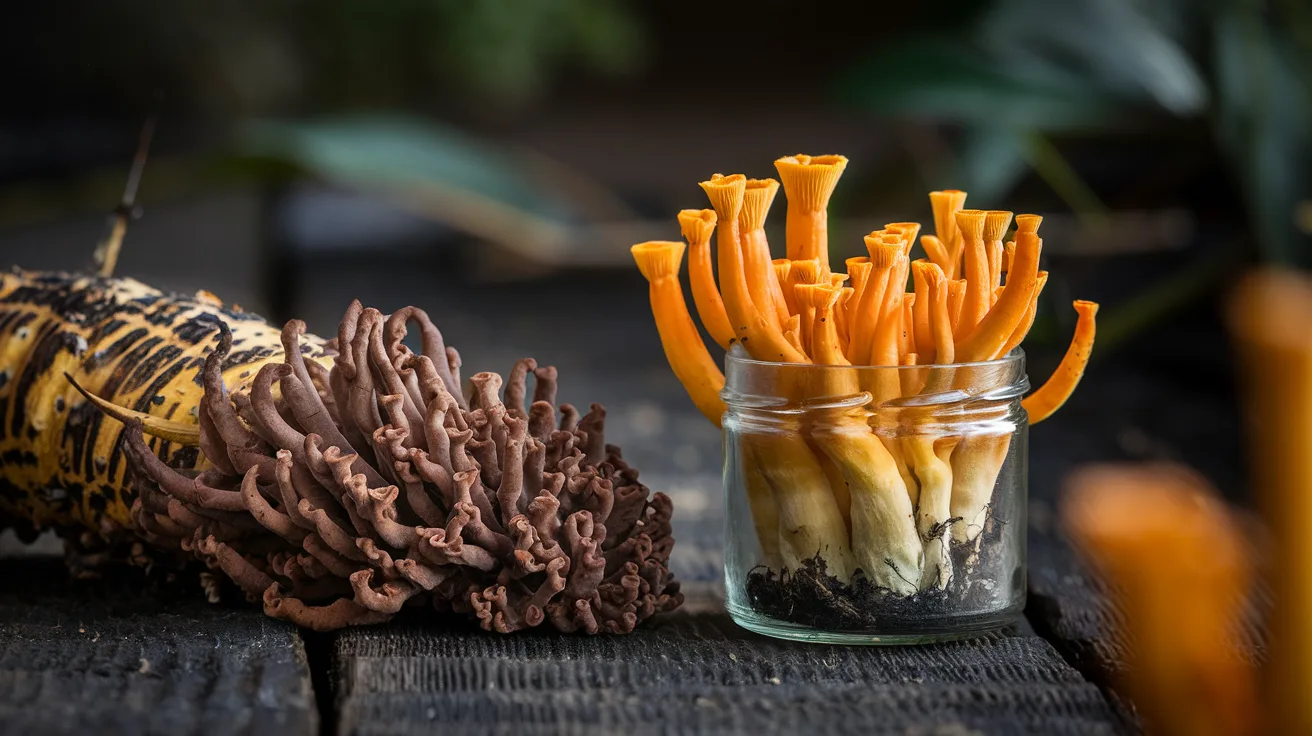
Cordyceps sinensis — renamed Ophiocordyceps sinensis in 2007 by taxonomists who love ruining simple things — is a parasitic fungus from the Tibetan Plateau. Grows above 3,800 meters. Infects ghost moth caterpillars. Slowly replaces the bug's insides with fungal mycelium. Then shoots a brown stalk out of the caterpillar's head.
(Mycology is metal.)
This stuff costs $20,000 to $60,000 per kilogram. Sometimes more. Families in Nagqu Prefecture, Tibet, make their entire year's income harvesting it each spring. There've been territorial fights over collection grounds. Fatal ones. National Geographic covered the economics — whole villages relocate to the harvesting areas every May.
And nobody can grow it in a lab. The Chinese government has dumped funding into this problem since the 80s. Forty years. Can grow the mycelium in tanks, sure. But the actual fruiting body — the mushroom that sprouts from the dead caterpillar — nope. Not commercially viable. Not in 2026, not yet.
So that $30 Amazon bottle labeled "Cordyceps sinensis"? You're getting Cs-4. That's a mycelium strain (Paecilomyces hepiali) fermented on grain. Not mushroom. Mycelium on rice or oats. Independent labs have tested these products and found 60-70% grain starch by weight.
My oatmeal experience makes more sense now.
The Orange Fingers
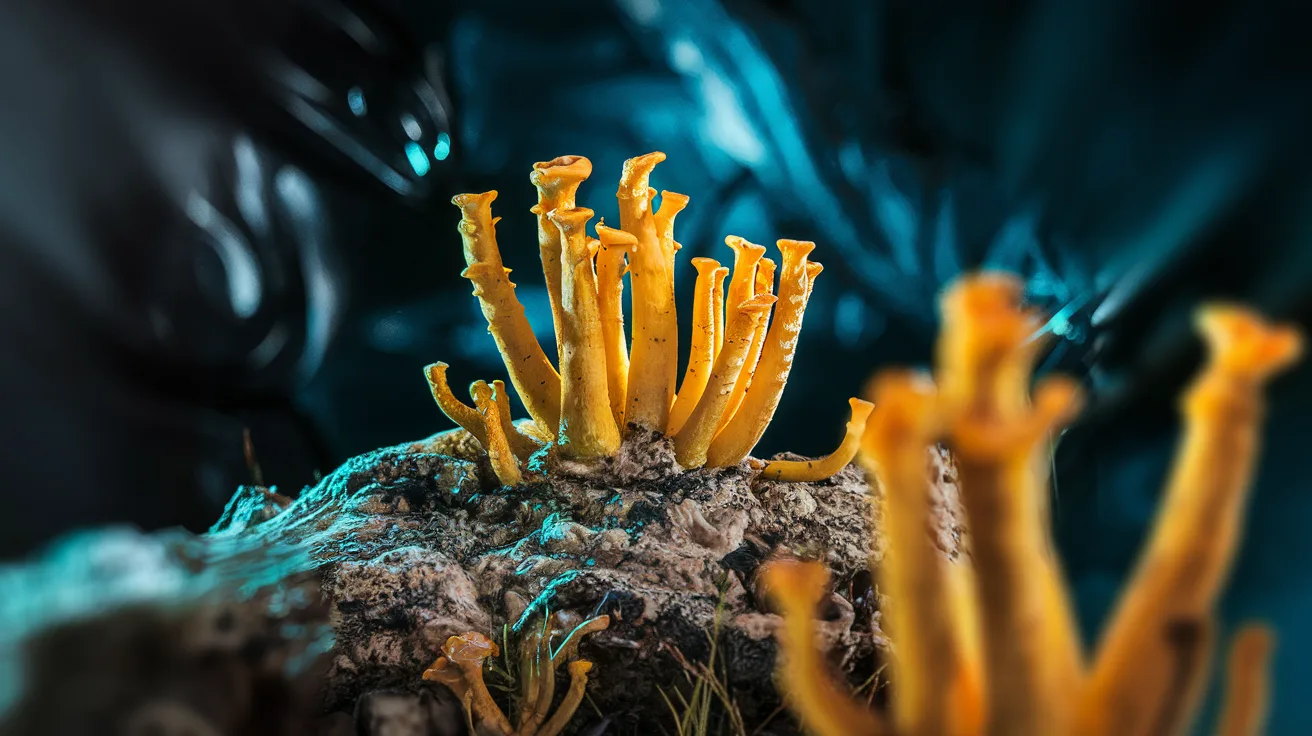
Cordyceps militaris looks completely different. Bright orange. Like tiny traffic cones growing out of substrate. I saw fresh ones at an Oregon Mycological Society meetup in Portland last October — genuinely alien-looking. Beautiful though.
The critical difference: you can farm militaris. South Korean growers have been doing it commercially since the early 2000s. Full fruiting bodies grown on brown rice in climate-controlled rooms. Real mushroom, not mycelium-on-grain.
Then in 2008, researchers at Chungbuk National University published something in the Journal of Agricultural and Food Chemistry that broke my brain a little when I first read it.
They measured cordycepin — that's 3'-deoxyadenosine, the bioactive compound driving most cordyceps research on energy and athletic performance — in both species.
Militaris had 90 times more.
Read that again. Not nine times. Not nineteen. Ninety. Wild sinensis contains maybe 0.02-0.06% cordycepin. Cultivated militaris hits 0.2-0.4%.
The "cheap cultivated" species absolutely destroys the "$60K per kilo wild" species on the compound that actually matters. I re-read that paper at 1am on my couch three times thinking I was missing something. I wasn't. Multiple subsequent studies confirmed it. A 2025 metabolomics paper using UHPLC-MS/MS (published in PMC) showed the two species have genuinely distinct chemical profiles — not just "more or less of the same stuff" but fundamentally different metabolite fingerprints.
What The Test Results Actually Say
After my oat powder incident, I became a COA stalker. Certificate of Analysis — the lab test results that tell you what's actually in a supplement. Our COA reading guide explains how to interpret these. Changed how I shop.
Cordycepin: Militaris. Ninety times more. Done.
Beta-glucans: These are the immune-modulating polysaccharides — the reason people take medicinal mushrooms at all. Good militaris fruiting body extracts test 25-30% beta-glucans. Most Cs-4 products? Don't even list beta-glucan content on the label. Suspicious, right? When third-party labs test them, the high starch percentage tells you everything. Can't have robust beta-glucans when your product is mostly rice.
Adenosine: Both species have it. Wild sinensis historically tested higher. Doesn't matter much practically because cordycepin is the bigger deal for energy.
A guy I talked to at SupplySide West — works at one of the bigger extract companies, asked to stay anonymous — told me they routinely test competitor cordyceps products. "Half the bottles on Amazon are grain with a dusting of mycelium. Consumers can't tell." His words, not mine.
Being Fair About Cs-4
Some Reddit threads call Cs-4 a total scam. That's too far. Real clinical trials exist — mostly Chinese, mostly from the 90s and 2000s — showing respiratory and fatigue benefits. The Chinese State FDA approved it. Jeff Chilton from Nammex (been in mushroom cultivation since 1973, basically the godfather of the North American mushroom extract industry) acknowledges Cs-4 has a legitimate research base.
The problem is packaging. Slap a photo of wild caterpillar fungus on the bottle. Write "Cordyceps sinensis" in big letters. Bury "mycelium biomass cultured on grain" in the fine print. Let consumers assume they're getting something resembling the legendary Tibetan stuff. Not technically illegal. Definitely gross.
What Happened After I Switched
Bought a militaris fruiting body extract eight months ago. Hot water extracted, COA verified: 0.3% cordycepin, 28% beta-glucans. $34 for 60 days. From a company in Carlsbad.
Week three, my 3pm espresso habit just... stopped. Not dramatically. I just noticed I wasn't craving it. Energy held through the afternoon.
My wife noticed before I did, actually. "You haven't made espresso after lunch in like two weeks." That's my n=1 anecdata. Make of it what you will. But the 90x cordycepin difference makes the placebo explanation feel like a stretch.
How I Actually Take This Stuff
People DM me about dosing so here's what I do. 1,000mg with breakfast. Capsules, not powder — I tried mixing powder into smoothies and it tasted like dirt. Like actual dirt from a garden. Some mornings I double up to 1,500 if I've got a packed schedule.
Morning only. I learned this one the hard way. Forgot my morning dose one Tuesday, popped it around 4pm instead. Lay in bed staring at the ceiling until 1:30am. My brain would NOT shut off. Took it exactly once in the afternoon. Never again.
This lines up with what I've read — cordycepin bumps ATP production, which is great when the sun's up, terrible when you're trying to sleep. Our supplement timing guide covers the why behind this for different mushroom species. Short version for cordyceps: before 2pm, with food.
Clinical trials typically run 1,000-3,000mg daily for a month or longer before measuring results. You gotta be patient. Week one, nothing. Week two, maybe nothing. Week three for me is when the espresso cravings stopped. That tracks with what researchers see — this stuff builds up gradually.
Who Should Maybe Not Do This
I'm not a doctor and don't play one on the internet. That said — blood thinners and cordyceps don't mix well. Cordycepin has anticoagulant properties. My uncle's on warfarin and I specifically told him to ask his cardiologist before touching any cordyceps product. He did. Doc said no.
Autoimmune stuff is a gray area. Cordyceps modulates immune function which sounds great until you remember that "modulate" can go both directions. If your immune system is already attacking your own tissue, ramping it up further isn't ideal. Talk to someone who actually went to medical school.
Everyone else? Safety record is genuinely good. People in East Asia have eaten militaris as food — literally just cooked and eaten — for centuries. Cultivated versions on rice substrate are arguably even safer since you control the growing conditions. No heavy metals from wild harvesting, no insect pathogens.
Worst thing that happened to me: stomach felt weird days 1 through 3. Gone by day 4. My buddy Mike — same thing. His girlfriend started the same batch, felt nothing negative at all. Bodies don't read the same manual.
My Buying Checklist (Steal It)
Species on the label: Must say "Cordyceps militaris" specifically. Just "Cordyceps" with no species? Hard pass. Check our 2026 functional mushroom guide for why species ID matters across all medicinal mushrooms.
Fruiting body: For militaris — non-negotiable. "Fruiting body extract." If it says mycelium or mycelial biomass, it's the grain product.
Beta-glucan percentage: Listed. Above 25%. No number = they don't want you to see it.
Cordycepin standardized: Best militaris products list exact cordycepin content. 0.2% minimum.
Third-party COA: Email the company. Ask. If they ghost you? They don't want you seeing their lab results.
Starch test: High starch = grain filler. The smoking gun.
One more thing — if you're building a mushroom stack (cordyceps plus lion's mane, reishi, whatever), each product's quality matters independently. Stacking five bad supplements doesn't somehow create one good one.
Militaris is what I take. What I tell friends to buy when they ask. The science is clear, the price is fair, and you can actually verify what you're getting. Don't spend $40 on oat powder like I did. Read the damn label.
What the Research Shows: Key Studies Compared
A 2011 paper in the Asian Pacific Journal of Tropical Medicine quantified cordycepin content across species. Wild Cordyceps sinensis: 0.01-0.04% by dry weight. Cordyceps militaris fruiting body: 0.15-0.55% by dry weight. That's 10-90x more cordycepin in militaris depending on the specific samples. Cordycepin is the compound most directly linked to adenosine receptor effects and ATP production enhancement. This single fact makes the militaris vs sinensis debate largely settled for supplement purposes.
Hirsch et al. 2017 used 4g/day of powdered militaris fruiting body in 14 young adults over 14 days. VO2 peak increased by 11% in the militaris group versus 1.3% in placebo. Time to exhaustion increased significantly. Large effect size for a two-week intervention in healthy subjects who already have decent fitness.
Wang et al. 2012 used CS-4 fermented mycelium (liquid fermentation, not MOG) and showed improvements in fatigue markers and exercise capacity — confirming CS-4 via liquid fermentation is legitimate. This is the exception that proves the rule: liquid-fermented mycelium without grain substrate is real; mycelium-on-grain isn't.
Who Should (and Shouldn't) Take Cordyceps
Ideal candidates: endurance athletes, regular exercisers, people dealing with chronic fatigue not driven by anemia or thyroid issues, high-altitude travelers who want to accelerate acclimatization. Not ideal: people expecting strength sport performance enhancement (limited evidence); those looking for immediate stimulant effects (cordyceps is not caffeine). Use caution with: autoimmune conditions (immune-modulating properties), diabetics on medication (blood-sugar-lowering effects may potentiate medication).
How to Stack Cordyceps
Cordyceps + Lion's Mane: physical + cognitive performance, available in most mushroom coffees. This is the most popular combination. Cordyceps + Turkey Tail: for athletes who train heavily and get sick frequently — cordyceps handles energy while turkey tail provides immune support during periods of training-induced immune suppression. Cordyceps + Reishi: energy during the day (cordyceps morning), stress modulation and recovery overnight (reishi evening). Full protocols with doses and timing in our stacks guide.
Frequently Asked Questions
Why is Cordyceps militaris better for supplements than sinensis?
Three reasons: 1) Militaris contains 10-90x more cordycepin by dry weight than wild sinensis. 2) Militaris grows under controlled conditions with verifiable quality. 3) Authentic wild sinensis is prohibitively expensive ($10,000-$30,000/kg) and almost universally adulterated commercially — a 2019 study found fewer than half of 30 commercial sinensis products contained authentic sinensis material. The compound you're paying for — cordycepin — militaris delivers more of it, more reliably, at a fraction of the price.
What does cordycepin actually do in the body?
Cordycepin (3'-deoxyadenosine) acts on adenosine receptors and appears to upregulate SIRT1 and PGC-1α — proteins involved in mitochondrial biogenesis. Over time: more and better mitochondria, more efficient ATP production, better aerobic endurance and energy. Unlike caffeine (which blocks adenosine receptors to prevent tiredness signals), cordycepin positively modulates the energy production pathways themselves. It's building capacity, not suppressing fatigue signals.
Can I find good cordyceps at a headshop?
Some headshops carry quality cordyceps, but online specialty retailers have a significant quality advantage for this category. The best militaris products come from companies focused specifically on functional mushrooms with full COA transparency. Ask for the COA before buying anything in-store. Our capsules category lists quality-verified options with comparison data.
How much cordyceps do I need to actually feel something?
The Hirsch study that showed 11% VO2 max improvement used 4,000mg/day of powdered militaris fruiting body. For a quality extract (25%+ beta-glucans), 1,500-2,000mg daily is typically equivalent. Start at 1,000mg and go up if you don't notice anything after 2 weeks. Effects build over days to weeks; don't judge it after one dose.
Does cordyceps affect testosterone?
Animal studies show cordyceps extracts increasing testosterone markers in isolated cells. Limited human data exists, and it's mixed. Don't buy it specifically for testosterone effects — the athletic performance data is solid enough to justify it on those merits alone. The traditional Chinese use of cordyceps for sexual vitality is where this claim originates, but clinical evidence in humans is weak and inconsistent.
Cordyceps in the Broader Functional Mushroom Stack
Cordyceps militaris doesn't exist in a vacuum. Understanding how it fits into a complete functional mushroom approach clarifies both its role and its limitations.
In a full daily mushroom stack, cordyceps typically fills the "energy and physical performance" role. Lion's mane handles cognitive performance and neural health. Reishi manages stress, sleep, and HPA axis regulation. Turkey tail covers immune surveillance. Chaga provides antioxidant defense. Tremella supports skin and cellular health. Each species has a primary domain, and cordyceps' primary domain is physical energy systems and oxygen efficiency — the reason it's most popular with athletes and people who feel chronically fatigued.
What cordyceps does NOT do particularly well: acute cognitive sharpening (that's lion's mane's domain), sleep improvement (that's reishi), or direct antioxidant defense (that's chaga's domain). People who start with cordyceps hoping to feel sharper mentally are often disappointed — what they're noticing is that their physical energy is better, which has downstream effects on mental clarity, but it's not the same as the direct NGF pathway that lion's mane activates.
The most common mistake in cordyceps supplementation: buying it for mental energy, taking it for a week, not noticing the specific benefit they were hoping for, and quitting. The specific benefit to evaluate is: are your workouts better? Do you feel less breathless at the same effort level after 2 weeks? Does your resting heart rate improve over a month? These are the measurable outcomes for cordyceps. Mental energy and focus are real but indirect benefits that come from better physical energy rather than direct neurocognitive enhancement.
For anyone wanting the complete picture of functional mushroom species, their roles, and how to combine them effectively, our complete 2026 functional mushrooms guide covers every major species in the same depth as this article. The stacks guide shows exactly how to combine cordyceps with other species for different health goals. Quality sourcing options are in our capsules and tinctures categories.
The Environmental Case for Choosing Militaris
There's an environmental and conservation angle to the militaris vs sinensis question that rarely gets discussed but deserves attention: the wild harvest of Cordyceps sinensis is having measurable ecological impacts on the Tibetan Plateau.
Cordyceps sinensis has become so valuable ($10,000-$30,000/kg) that it now constitutes a significant portion of rural income in the collection zones of Tibet, Nepal, Bhutan, and parts of Yunnan Province. This isn't inherently problematic — sustainable wild harvest of fungal species is possible. The problem is that collection intensity has dramatically increased as prices have risen. Multiple studies tracking yield in traditional collection areas show declining per-area harvests as collection pressure outpaces the reproductive capacity of the fungus-host system. The caterpillar population (the host organism for sinensis) in some areas has declined significantly.
The sinensis market has also driven habitat disruption. Collectors range into increasingly remote and ecologically sensitive high-altitude zones, creating trails, waste, and disturbance in areas that previously had minimal human impact. Climate change is simultaneously reducing suitable habitat at the altitudes where sinensis thrives, compressing the collection zones and increasing pressure on remaining productive areas.
Cordyceps militaris, by contrast, is cultivated. No wild harvest. No caterpillar hosts. No high-altitude ecological pressure. Consistent supply regardless of weather patterns or climate. Lower price reflecting the cultivated production model rather than scarcity rents. And — as the research shows — higher cordycepin content per unit weight than wild sinensis. The environmentally responsible choice and the higher quality choice happen to be the same thing. This is rare in the supplement world and worth celebrating. Buy militaris, get better cordycepin content, and don't contribute to high-altitude ecosystem degradation. Everyone wins except the wild sinensis adulteration industry.
Find quality Cordyceps militaris fruiting body extract in our capsules category. When evaluating any cordyceps product, verify it specifies militaris (not sinensis), fruiting body (not mycelium), and has a COA showing cordycepin content above 0.15% and beta-glucans above 20%. These three criteria together filter out the majority of low-quality products. For broader context on evaluating all functional mushroom products, our COA reading guide covers the full verification process.
The Bottom Line: Just Buy Militaris
After all the analysis, the practical conclusion is simple: if you're buying a cordyceps supplement for any health or performance purpose, buy Cordyceps militaris fruiting body extract with a verified COA showing cordycepin content above 0.15% and beta-glucans above 20%. Nothing else consistently meets the standard for quality, authenticity, efficacy, and environmental responsibility simultaneously.
The sinensis mythology — the idea that wild Tibetan caterpillar mushroom is somehow more potent or authentic than cultivated militaris — is a marketing story that benefits importers, distributors, and brands that can charge premium prices for scarcity claims that the analytical chemistry doesn't support. The compound you're paying for is cordycepin. Militaris has more of it, reliably, in every batch, than wild sinensis even if you could be certain the sinensis was authentic — which you almost certainly cannot.
The CS-4 liquid fermentation exception: if a brand specifically uses CS-4 cordyceps mycelium grown via liquid fermentation (not grain cultivation), and they can provide documentation of the fermentation process and the resulting compound profile, this is a legitimate form of cordyceps with real research behind it. It's the narrowly defined exception, not the rule. Most products labeled "CS-4" are still mycelium-on-grain despite the research-associated branding. Ask for documentation before assuming.
For cordyceps militaris fruiting body extract, look in our capsules category for quality-verified products. If you prefer liquid delivery, some tinctures also offer quality militaris extracts. And when sourcing in person, use our headshop finder to locate retailers who carry brands with COA documentation and transparent sourcing practices.
Tags
Medically Reviewed By
Dr. Igor I. Bussel, MD
Board-certified physician affiliated with the University of California, Irvine (UCI), the Gavin Herbert Eye Institute, and the UCI School of Medicine.
Related Articles
⚖️ Product Comparisons
Explore the Mushroom World
Dive deeper into species profiles, compare products, and find stores near you.